
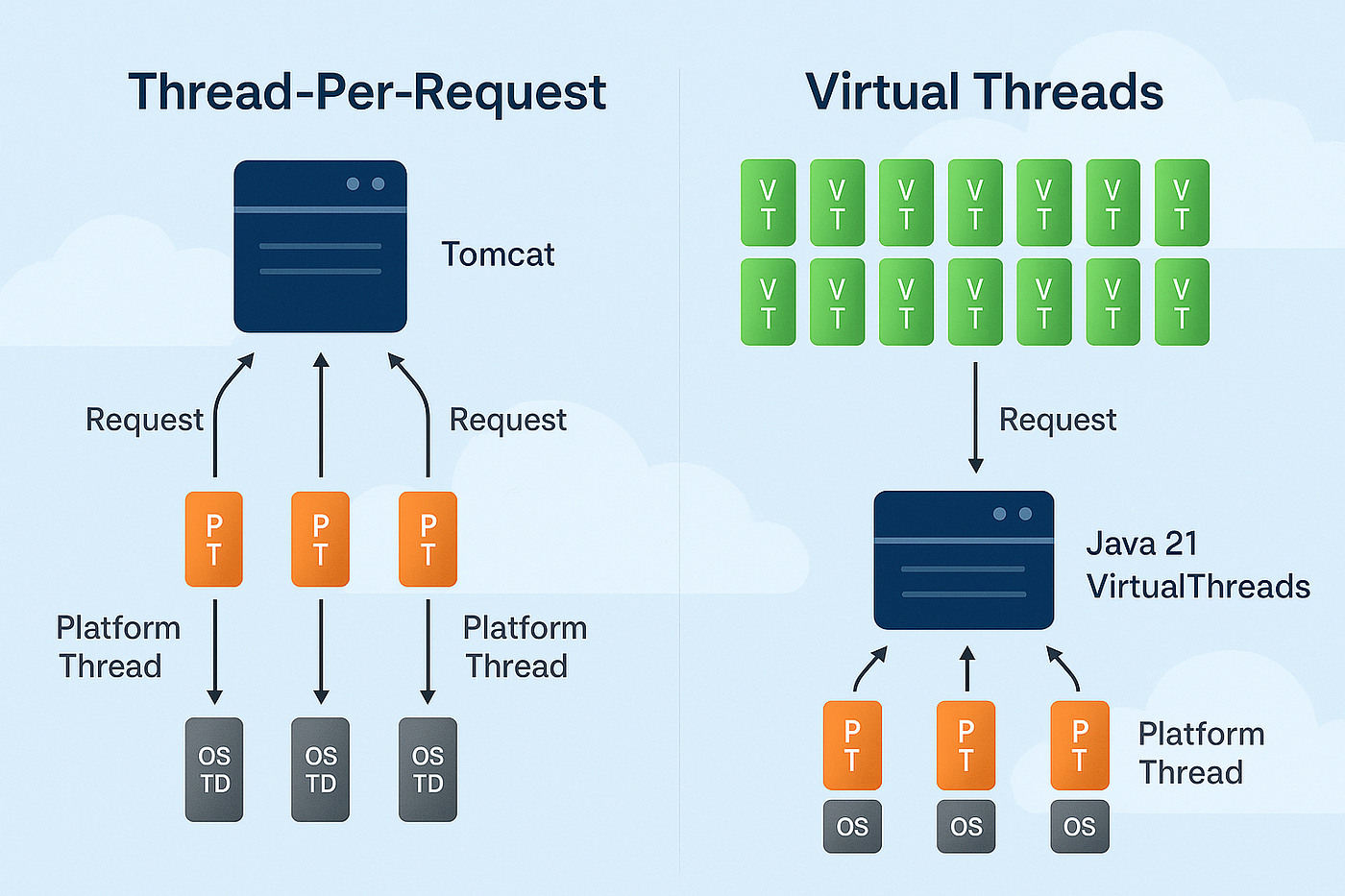
In 2026, both Node.js and Java (21+ with virtual threads) are among the strongest choices for building highly concurrent backend systems — yet they follow completely opposite philosophies.
- Node.js → single-threaded JavaScript + event loop + non-blocking I/O
- Java 21+ → millions of lightweight virtual threads + synchronous-looking code
Which one actually handles concurrency better today?
Here’s a realistic, up-to-date comparison.
How Node.js Handles Concurrency (Event Loop Architecture)
Node.js remains single-threaded for JavaScript execution in 2026.
All your business logic runs on one thread, but almost everything else is offloaded.
Core components
- libuv → manages asynchronous I/O
- Event loop phases → timers → pending → poll → check → close
- Thread pool (default 4 threads) → file system, DNS, crypto, compression
- worker_threads → real parallelism since Node 10–12 (very mature in 2026)
Result: Node.js routinely handles 80,000–250,000+ concurrent connections on one process when the workload is I/O-bound (HTTP, WebSocket, database queries, streaming).
Biggest weakness: Any long-running CPU-bound task blocks the entire event loop.
How Java 21+ Virtual Threads Work (Project Loom)
Virtual threads are JVM-managed, ultra-lightweight threads (~1–4 KB each).
Key mechanics
- You write normal blocking/synchronous code
- When a virtual thread blocks (e.g.
httpClient.send(), JDBC query,Files.readAllBytes()), the JVM unmounts it from its carrier (platform) thread - The carrier thread immediately picks up another virtual thread
- When I/O completes → virtual thread is remounted and continues
Outcome: You can create hundreds of thousands (often 100k–500k) concurrent tasks without exhausting OS threads or memory.
Main limitations in practice:
- Pinning (when a virtual thread holds a synchronized block or native call for too long)
- Still need real OS threads (carriers) ≈ number of CPU cores for CPU parallelism
- Debugging & observability of 200k+ threads is more complex
Head-to-Head Comparison – 2026 Reality
| Criterion | Node.js (Event Loop + libuv) | Java 21+ (Virtual Threads) | Slight 2026 Winner |
|---|---|---|---|
| Primary concurrency model | Single-threaded JS + async I/O | Many lightweight virtual threads | — |
| Code style | async/await, Promises | Classic synchronous / blocking style | Java (readability) |
| Max realistic concurrent tasks | 80k–250k+ (pure I/O) | 100k–500k+ (mixed workload) | Java |
| CPU-bound performance | Poor without worker_threads | Good — spreads across cores | Java |
| I/O-bound throughput (RPS) | Usually 5–15% higher | Very close, sometimes equal or higher | Node.js |
| Memory footprint (100k connections) | Very low | Low–moderate (JVM overhead) | Node.js |
| Startup time (serverless) | Excellent (~80–300 ms) | Good (~300–1200 ms) | Node.js |
| Multi-core scaling | Requires cluster + workers | Native — virtual threads spread work | Java |
| Debugging concurrency | Easier (single thread) | Harder (many threads) | Node.js |
| Ecosystem maturity (web APIs) | Extremely strong | Extremely strong (Spring, Quarkus, Micronaut, Helidon) | Tie |
| Best language fit | JavaScript / TypeScript teams | Java / Kotlin teams | — |
Realistic Performance Numbers (2026 Benchmarks Summary)
Approximate medians from public benchmarks, TechEmpower, production reports and community tests (early 2026)
| Workload | Node.js (cluster + workers) | Java (Virtual Threads) | Notes |
|---|---|---|---|
| 100k keep-alive HTTP connections | 110–160k | 90–140k | Node.js often wins pure I/O |
| 50k RPS plain JSON API | 60–85k req/s | 55–78k req/s | Node.js slight edge |
| 10k concurrent pooled DB queries | Excellent | Excellent | Tie |
| 5k long-polling WebSockets | Very good | Very good | Tie |
| CPU-heavy endpoint (1s crypto / hash) | Poor without workers | Good | Java clear winner |
| Mixed I/O + medium CPU | Good | Very good | Java advantage |
When to Choose Node.js in 2026
- Your team is already strong in JavaScript/TypeScript
- You need maximum I/O throughput and lowest latency (API gateways, proxies, real-time)
- Serverless / edge functions (fast cold starts)
- Very mature ecosystem for WebSocket, streaming, GraphQL
- You prefer simpler concurrency debugging
When to Choose Java + Virtual Threads in 2026
- You have a large Java / Kotlin codebase or team
- You want classic readable blocking code instead of async/await chains
- Mixed I/O + CPU-bound workloads
- Enterprise microservices that need strong multi-core scaling
- You value type safety, mature observability, and huge ecosystem (Spring Boot 3.3+, Quarkus 3.8+, Micronaut)
Quick Recommendation Table – 2026
| Your priority | Best choice |
|---|---|
| Pure I/O throughput & lowest latency | Node.js |
| Readable blocking-style code | Java virtual threads |
| Maximum CPU parallelism without extra work | Java virtual threads |
| Fastest serverless / edge cold starts | Node.js |
| Large existing Java enterprise codebase | Java + virtual threads |
| JavaScript / TypeScript team | Node.js |
| Mixed I/O + CPU workloads | Java virtual threads |
FAQ
Does Java virtual threads make Java faster than Node.js in 2026?
For pure I/O — usually no, Node.js still has a small edge.
For mixed or CPU-bound workloads — yes, Java often performs better.
Can Node.js handle as many concurrent connections as Java virtual threads?
Yes — often 100k–250k+ on good hardware when workload is I/O bound.
Is the Node.js event loop still single-threaded in 2026?
Yes for JavaScript execution. But I/O, file system, crypto etc. are offloaded.
Should I migrate my Node.js app to Java because of virtual threads?
Almost never — only if you have painful CPU bottlenecks or a strong Java team.
Which framework is best for virtual threads?
Quarkus 3.8+ and Spring Boot 3.3+ both have excellent support. Quarkus usually wins on memory & startup time.
Both platforms are excellent in 2026.
Choose the language and mental model your team is most productive with.
Happy coding — whether you’re awaiting promises or unmounting virtual threads! 🚀
Last updated February 2026 — based on Node.js 22.x, Java 21/23, Spring Boot 3.3+, Quarkus 3.8+