TCP State Transition Diagram: The Ultimate Guide for Network Professionals
The TCP State Transition Diagram is a fundamental tool for understanding how TCP (Transmission Control Protocol) ensures reliable, ordered, and error-checked data transmission across networks. Whether you're a network engineer troubleshooting connectivity issues, a student preparing for the CCNA, or a developer optimizing application performance, mastering this diagram is essential.
In this comprehensive guide, we’ll break down:
✔ What the TCP State Transition Diagram is and why it matters
✔ TCP connection establishment (three-way handshake)
✔ TCP connection termination (four-way handshake)
✔ Key states explained with real-world examples
✔ Common FAQs and troubleshooting insights
Let’s dive in!
What is a TCP State Transition Diagram?
The TCP State Transition Diagram is a finite state machine (FSM) that visually represents the lifecycle of a TCP connection. It maps all possible states (e.g., LISTEN, SYN_SENT, ESTABLISHED) and transitions triggered by events like sending or receiving TCP segments (SYN, ACK, FIN).
Why is it Important?
- Ensures reliability: TCP guarantees data delivery using acknowledgments, retransmissions, and proper connection teardown.
- Critical for troubleshooting: Understanding states helps diagnose issues like half-open connections or
TIME_WAITdelays. - Foundational for network protocols: HTTP, HTTPS, FTP, and SSH all rely on TCP’s stateful behavior.
Key Components of the Diagram
| Component | Description |
|---|---|
| States | Represent the current phase of a TCP connection (e.g., CLOSED, ESTABLISHED). |
| Transitions | Movement between states triggered by sending/receiving packets (e.g., SYN → SYN_RCVD). |
| Events | Actions like send(), receive(), or timeouts that cause state changes. |
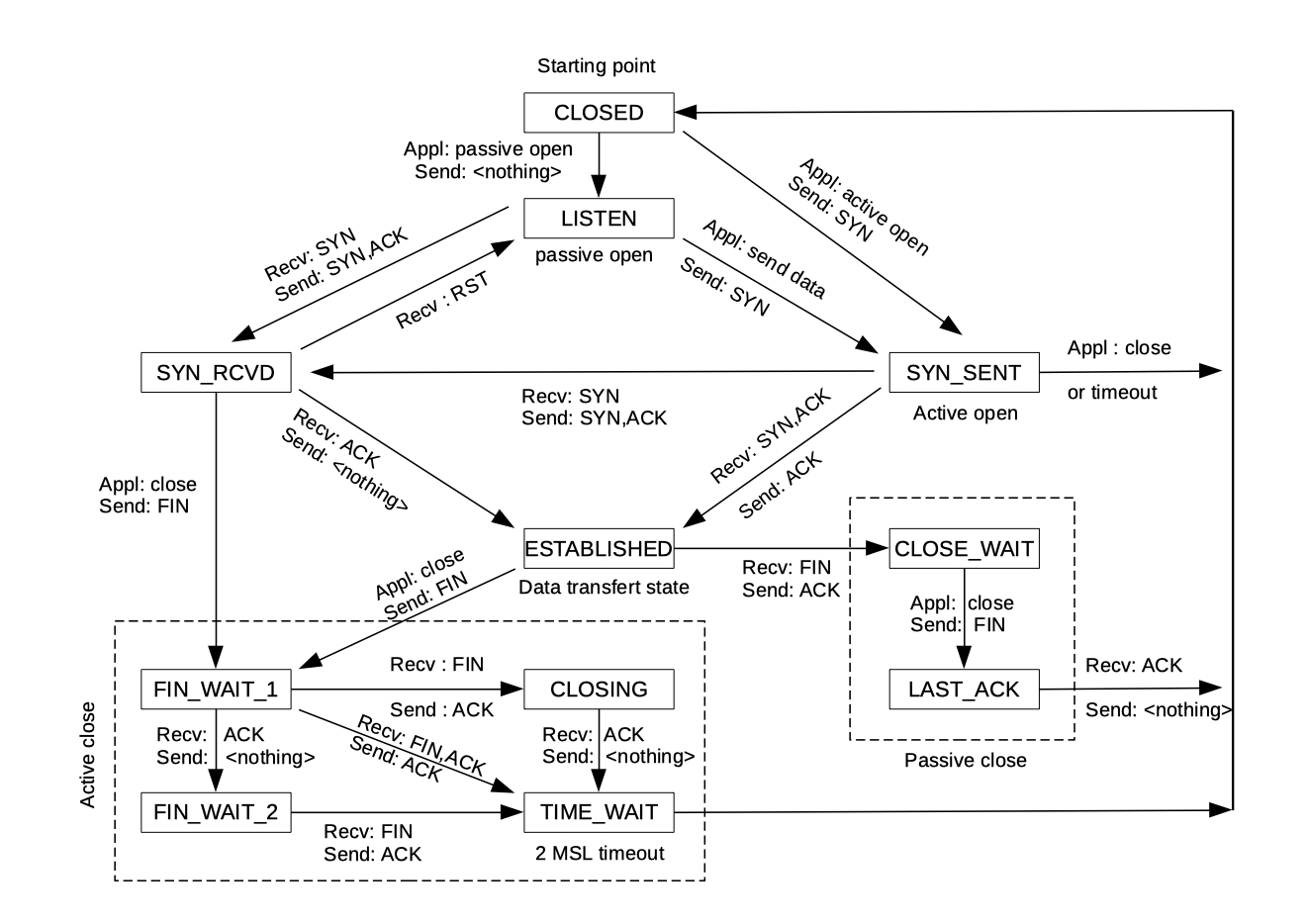 (Source: IBM Documentation)
TCP Connection Establishment: The Three-Way Handshake
Before data transfer begins, TCP performs a three-way handshake to synchronize sequence numbers and establish a reliable connection.
Step-by-Step Process
SYN(Client → Server)- Client sends a
SYNpacket (with a random initial sequence number). - Moves to
SYN_SENTstate.
- Client sends a
SYN-ACK(Server → Client)- Server acknowledges the
SYNand sends its ownSYN. - Moves to
SYN_RCVDstate.
- Server acknowledges the
ACK(Client → Server)- Client acknowledges the server’s
SYN. - Both sides transition to
ESTABLISHEDstate.
- Client acknowledges the server’s
Real-World Example:
When you visit google.com, your browser (client) initiates a SYN to Google’s server, which responds with SYN-ACK. Your browser then sends an ACK, completing the handshake.
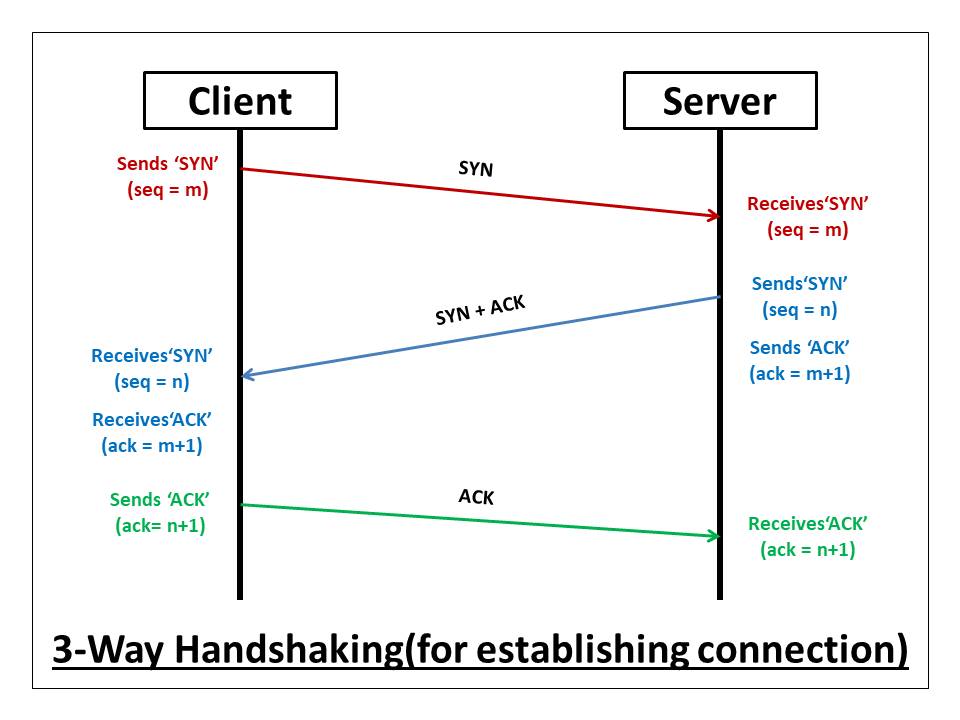 (Source: afteracademy)
TCP Connection Termination: The Four-Way Handshake
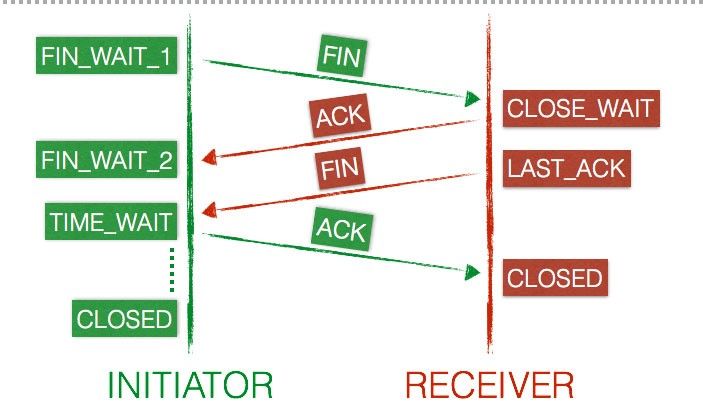
TCP connections close gracefully using a four-way handshake, allowing each side to terminate independently.
Step-by-Step Process
FIN(Client → Server)- Client initiates closure by sending
FIN. - Moves to
FIN_WAIT_1.
- Client initiates closure by sending
ACK(Server → Client)- Server acknowledges
FINand moves toCLOSE_WAIT. - Client moves to
FIN_WAIT_2.
- Server acknowledges
FIN(Server → Client)- Server sends its own
FIN. - Moves to
LAST_ACK.
- Server sends its own
ACK(Client → Server)- Client acknowledges the
FINand entersTIME_WAIT(waits 2x MSL). - Server closes upon receiving
ACK.
- Client acknowledges the
Why TIME_WAIT?
- Prevents delayed packets from interfering with new connections.
- Default duration: 60 seconds (2x Maximum Segment Lifetime).
Common TCP States Explained
The TCP State Transition Diagram includes 11 states, each with a specific role in connection management. Below is a table summarizing key states:
| State | Description | Example Scenario |
|---|---|---|
| CLOSED | No active connection; starting point. | Before a client initiates a connection. |
| LISTEN | Server awaits a client’s SYN. | A web server waiting for browser requests. |
| SYN_SENT | Client sent SYN, awaiting SYN-ACK. | Browser initiating a webpage load. |
| SYN_RCVD | Server sent SYN-ACK, awaiting ACK. | Server after responding to a client’s SYN. |
| ESTABLISHED | Active connection for data transfer. | Browser and server exchanging webpage data. |
| FIN_WAIT_1 | Sent FIN to initiate termination. | Browser closing a tab. |
| FIN_WAIT_2 | Awaiting other side’s FIN after ACK. | Browser after server acknowledges FIN. |
| CLOSE_WAIT | Received FIN, preparing to close. | Server after receiving client’s FIN. |
| LAST_ACK | Sent FIN, awaiting final ACK. | Server waiting for client’s final ACK. |
| TIME_WAIT | Ensures no stray segments disrupt closure. | Browser after final ACK, before closing. |
| CLOSING | Rare state for simultaneous FINs. | Both sides close simultaneously (uncommon). |
FAQs: Troubleshooting TCP States
❓ Why do connections get stuck in SYN_RCVD?
- Possible Cause: Server under heavy load (SYN flood attack) or firewall blocking
ACK. - Fix: Check server resources, adjust
tcp_max_syn_backlog.
❓ What happens if FIN is lost?
- TCP retransmits
FINuntilACKis received (or timeout occurs).
❓ Can TIME_WAIT be reduced?
- Yes, but cautiously:
sysctl -w net.ipv4.tcp_fin_timeout=30 # Reduces TIME_WAIT to 30s
❓ TCP vs. UDP: Why does TCP need states?
- TCP: Connection-oriented, ensures reliability.
- UDP: Stateless, no handshake or termination.
Conclusion
The TCP State Transition Diagram is your guide to understanding TCP’s reliable communication process. From the three-way handshake to the four-way termination, each state ensures robust data transfer. Whether you’re studying for a networking exam or optimizing network performance, this diagram is a must-know. Explore more networking tutorials on our blog, or leave a comment with your questions. Loved this guide?
Want to go deeper? Check out our advanced TCP/IP networking guide.
 Twitter